California has built solar panels over irrigation canals to tackle multiple issues at once and this is how it’s gone so far
Researchers estimate that covering 100 miles of Turlock’s narrower canals could eventually save enough water each year to supply around 2,700 households.
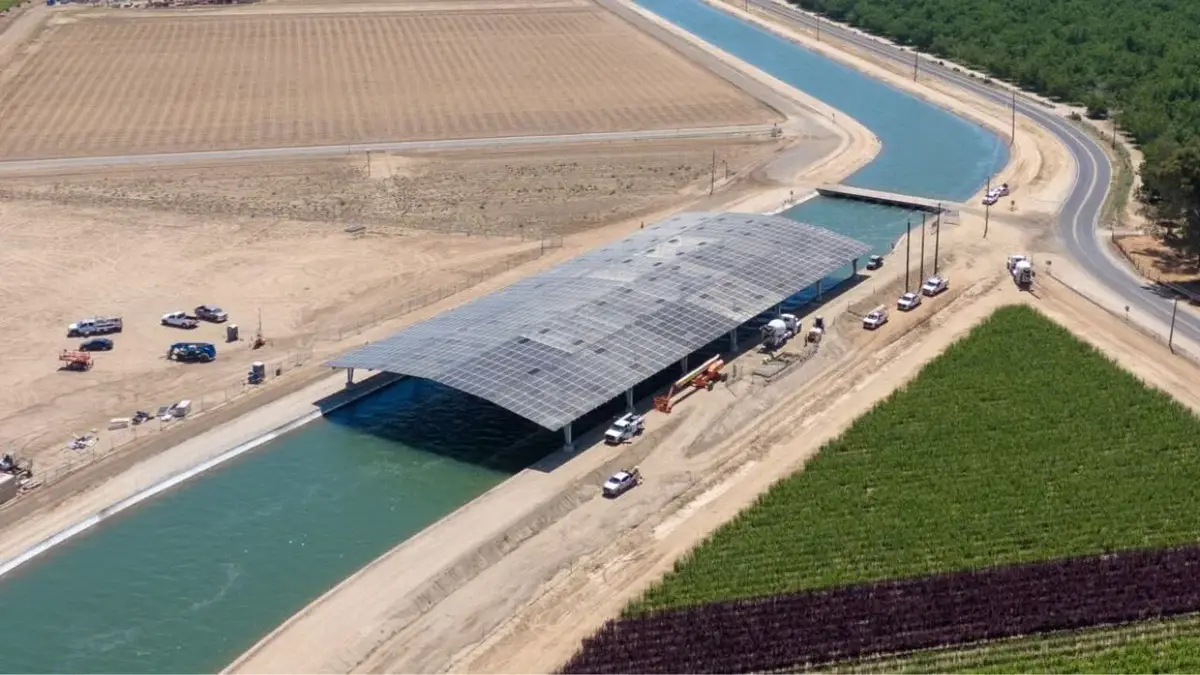

What’s new. Project Nexus has put solar panels over working canals in Turlock, California, and was switched on in 2025.
Early results. Researchers found less algae and aquatic weed growth in shaded areas, which could mean less maintenance.
Water savings. Covering 100 miles of Turlock’s narrower canals could eventually save enough water for around 2,700 households.
California is testing an unusual way to make better use of its vast network of irrigation canals using solar panels.
The solar panels have been installed above sections of the waterways, where they can generate electricity while tackling several other issues.
And while the idea might sound futuristic, places including India have already been experimenting with canal-top solar for years.
The panels are doing more than making electricity
California has around 4,000 miles of open canals carrying water to farms and communities, but plenty of that water can be lost to evaporation under the hot sun, so it was screaming out for some futuristic tech solution.
That is where Project Nexus comes in.
The project, developed with Turlock Irrigation District, UC Merced, California’s Department of Water Resources and Solar AquaGrid, has installed different designs of solar panels over sections of working canals in Turlock.

Three setups are being tested, including a huge canopy of the panels over a 115-foot-wide canal, traditional-looking panels over a narrower 20-foot canal, and retractable panels that can be moved when necessary.
The project was completed and switched on in 2025, and researchers have been monitoring what happens underneath the panels.
So far, the shade appears to be doing exactly what it was supposed to do, because researchers have found less algae and aquatic weed growth in the shaded areas, which could mean less maintenance and better water quality.

And there is potentially a pretty big water-saving bonus, too.
Researchers estimate that covering 100 miles of Turlock’s narrower canals could eventually save enough water each year to supply around 2,700 households, so covering the wider canals could save enough for around 11,000 households.

California isn’t the first to try the solar panels solution
The idea might look futuristic, but California isn’t actually the first place to look up when deciding where to put solar panels.
India has been experimenting with canal-top solar for more than a decade.
Gujarat launched a 1 MW pilot project over the Narmada canal in 2012, covering around 750 meters of canal and producing electricity while also reducing water evaporation.

That was followed by much larger projects, including a 10 MW installation over the Narmada canal in Vadodara that began generating electricity in 2014, and India has since developed canal-top solar projects in several other states.
There is also a nice space-saving element to the idea. Instead of finding huge areas of land for solar farms, the panels can make use of infrastructure that is already there.
It could be a win-win, but there is a catch
The early results are promising, but California isn’t about to cover every canal in solar panels just yet.
Project Nexus is still a relatively small experiment; it currently produces around 1.7 megawatts of electricity, which is tiny compared with the 56 megawatts produced by Turlock’s desert solar farm.

There are also some very practical problems to figure out, because canals come in wildly different shapes and sizes, and maintenance crews still need to get in there to clean them.
At Turlock, for example, workers use equipment and even drag a huge anchor chain through the water to remove weeds.
That is why the panels have been placed high above the canal rather than sitting close to the water like some installations elsewhere, and then there is the question of cost, permits and connecting all that new electricity to the grid.
For now, California is waiting for the project’s final report before deciding whether the concept should be rolled out more widely.
But the experiment has already shown that putting solar panels over canals can potentially tackle several problems at once - producing electricity, reducing water loss, keeping weeds and algae under control, and avoiding the need to cover more natural land with solar farms.