Scientists create the coldest temperature ever recorded in a lab and it’ll make you shiver just thinking about it
Researchers have cooled a cloud of atoms to set a new record for the coldest artificially created temperature - brrrr!
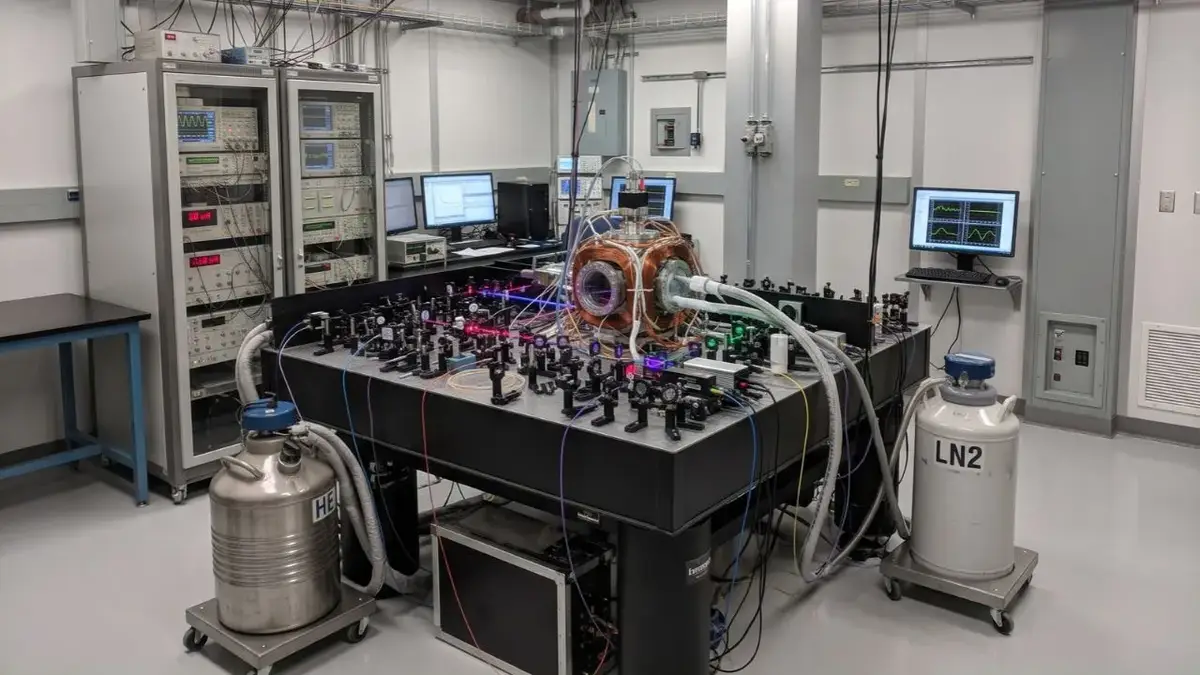

Record-breaking. Scientists achieved a temperature of 9.7 picokelvin, around four times colder than the previous record.
In space. The experiment took place aboard China’s Tiangong space station, where microgravity helped researchers cool the atoms further.
Quantum physics. The achievement could help scientists develop more precise space sensors and investigate some of the universe’s biggest mysteries.
Scientists have achieved something extraordinary by cooling a cloud of atoms to a temperature that is almost impossible to comprehend.
A research team managed to cool around 20,000 rubidium atoms to just 9.7 picokelvin.
That’s less than 10 trillionths of a degree above absolute zero, the theoretical point at which particles have their minimum possible thermal energy.
The experiment took place aboard China’s Tiangong space station, where researchers took advantage of the unusual conditions in orbit to push temperatures to a new extreme.
Scientists have created the coldest artificial temperature ever recorded
Getting something this cold is no easy task, particularly because gravity makes it harder to control and cool atoms, so space may be the solution.
On Earth, gravity can cause an atomic cloud to sag inside its trap, making it difficult to achieve the same extremely low temperatures.
The researchers instead used the microgravity environment aboard the Tiangong space station, where they could manipulate the atoms with greater precision.

They used a combination of laser cooling, evaporative cooling and optical traps to gradually reduce the energy of the rubidium atoms.
The final measurement was an astonishing 9.7 picokelvin, with an uncertainty range of 7.0 to 12.9 picokelvin.
The team also managed to observe the freely expanding atomic cloud for seven seconds, giving them more time to study its behavior than would typically be possible in a ground-based experiment.
For comparison, an earlier experiment by astronauts in a German drop tower achieved 38 picokelvin, while NASA’s Cold Atom Laboratory aboard the International Space Station previously reached 52 picokelvin.

The experiment took advantage of the conditions in space
The location of the experiment played a huge role in helping researchers achieve their record-breaking result.
On Earth, gravity can interfere with experiments involving ultracold atoms, limiting how long scientists can observe them and how far they can expand.
Microgravity offers a different environment, allowing atomic clouds to remain suspended for longer periods without the same gravitational interference.
The researchers used specialized equipment aboard the Tiangong space station to create and manipulate the ultracold atomic cloud.

This allowed them to push beyond temperatures previously achieved in laboratory experiments on Earth.
The achievement is particularly impressive because scientists are working with incredibly small differences in energy, meaning even minor disturbances can affect the results.
The discovery could help scientists explore quantum physics
While creating something incredibly cold is impressive in itself, the achievement could have much bigger implications for science.
At temperatures approaching absolute zero, atoms begin displaying unusual quantum behavior that is difficult to observe under normal conditions.
The researchers created a Bose-Einstein condensate, a state of matter in which atoms behave collectively as though they are one quantum system.

Studying these systems for longer periods could help scientists investigate unusual quantum states and improve experimental precision.
One particularly exciting possibility is developing space-based atom interferometers, which could be used to measure tiny changes in gravity and acceleration.
These instruments could eventually help scientists test fundamental principles of physics and improve measurements used in space navigation and Earth observation.
So while temperatures this low might make you shiver, the experiment could unlock some seriously exciting scientific discoveries.
A history of Chinese space temperature experiments
- 2015
Development of the space-based ultracold atom experiment began.
- October 2022
The experimental equipment was delivered to the Tiangong space station aboard the Mengtian laboratory module.
- Over the following three years
Researchers worked to refine the cooling system and overcome technical challenges.
- November 6, 2026
Peking University announced the record-breaking achievement.