NASA’s Voyager 1 is approaching a mind-boggling new milestone nearly 49 years after launch
NASA’s Voyager 1 is our most distant spacecraft and is preparing to make history once again with a milestone that shows how far humans have come.
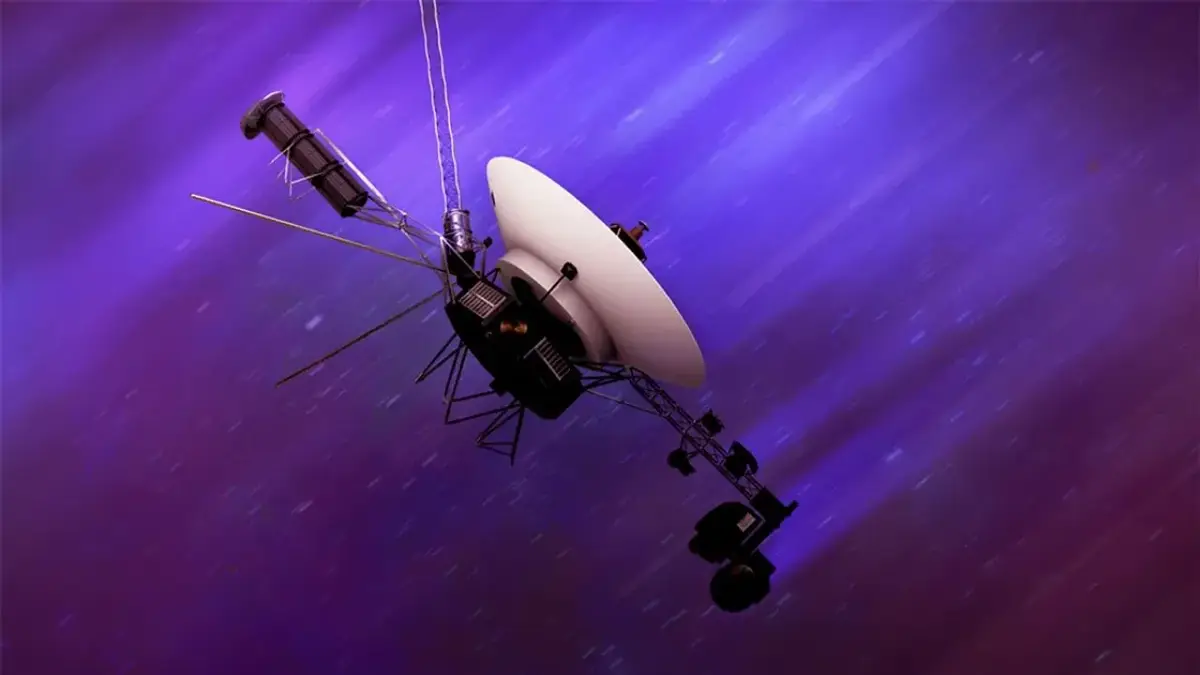

Launch. Voyager 1 launched on September 5, 1977, from Cape Canaveral, Florida.
Distance. It is the most distant human-made object, traveling around 38,000mph through interstellar space.
Endurance. Voyager 1 has been operating for nearly 49 years, far exceeding its original four-year planetary mission.
Launched in 1977, Voyager 1 has spent decades traveling farther from Earth than any other human-made object.
Now, the legendary spacecraft is approaching a distance so enormous that even a radio message from NASA takes an entire day to reach it.
The milestone is expected to happen on November 18, 2026, when the probe will be approximately 16.1 billion miles (25.9 billion kilometers) away.
And while the spacecraft has already made some incredible discoveries, its latest achievement is a reminder of just how much of the universe remains unexplored.
Voyager 1 is about to reach a distance no human-made object has reached before
NASA expects Voyager 1 to reach one light-day from Earth on November 18, 2026.
But what exactly does that mean?
A light-day is the distance light travels in 24 hours, which works out to approximately 16.1 billion miles (25.9 billion kilometers).
Light travels at around 186,000 miles per second, making this an almost unimaginable distance for a spacecraft launched from Earth.

The milestone also comes with a rather interesting communications challenge.
Because radio signals travel at the speed of light, any message sent from Earth to Voyager 1 will take approximately 24 hours to arrive.
If the spacecraft sends a response, that will take another 24 hours to make the journey home.
In other words, sending a message and getting a response could take around two days.
NASA has confirmed that Voyager 1 will become the first human-made object to reach this one-light-day distance.

From Jupiter and Saturn to the edge of interstellar space
Voyager 1 launched on September 5, 1977, just weeks after its twin spacecraft, Voyager 2.
The original mission was designed to explore the outer planets, with Voyager 1 making close encounters with Jupiter in 1979 and Saturn in 1980.
During its journey, it helped scientists discover new moons, investigate planetary rings and study the atmospheres of these distant worlds.

But its biggest adventure was still ahead.
On August 25, 2012, Voyager 1 became the first spacecraft to enter interstellar space, crossing the heliosphere - the enormous protective bubble of particles and magnetic fields generated by the Sun.
It is now traveling through the space beyond this boundary, continuing to collect scientific data from a region no other spacecraft has directly explored.
Despite its age, the probe is still communicating with NASA, although engineers have had to carefully manage its dwindling power supply by switching off instruments over the years.
The spacecraft also gave us one of the most famous pictures of Earth
Voyager 1 is responsible for one of the most iconic photographs ever taken of our planet.
On February 14, 1990, the spacecraft captured an image of Earth from billions of miles away, showing our home as a tiny speck suspended in a vast expanse of darkness.
The photograph became known as the ‘Pale Blue Dot’ and helped put the sheer scale of the universe into perspective.

Its cameras were subsequently switched off to conserve energy for the spacecraft’s continuing journey.
Now, more than 35 years after that photograph was taken, Voyager 1 is still pushing into the unknown.
Its one-light-day milestone won’t change anything aboard the spacecraft, but it will mark another extraordinary achievement for a mission that has lasted far longer than anyone could have imagined.
And with Voyager 1 still traveling at around 38,000mph, humanity’s most distant explorer isn’t finished just yet.
A brief history of Voyager 1
- September 5, 1977 - Launch
Voyager 1 launches from Florida aboard a Titan IIIE-Centaur rocket.
- December 15, 1977 - Overtakes Voyager 2
Despite launching later, Voyager 1 overtakes its twin thanks to its faster trajectory.
- March 5, 1979 - Jupiter flyby
It flies past Jupiter, discovering two new moons and a faint ring around the planet.
- November 12, 1980 - Saturn flyby
Voyager 1 explores Saturn and its largest moon, Titan, before heading out of the planetary region.
- February 14, 1990 - Pale Blue Dot
It photographs Earth from around 3.7 billion miles away, capturing the iconic image.
- February 17, 1998 - Distance record
Voyager 1 overtakes Pioneer 10 to become the most distant human-made object.
- August 25, 2012 - Interstellar space
It crosses the heliopause and becomes the first spacecraft to enter interstellar space.
- November 18, 2026 - One light-day
1. It is expected to reach 16.1 billion miles from Earth, making it the first human-made object one light-day away.