Makers of world’s first biological computer combine 15 living computers to forge a hive mind and outsmart AI
Computers powered by living human brain cells could be about to get a major upgrade, and the secret is teamwork.
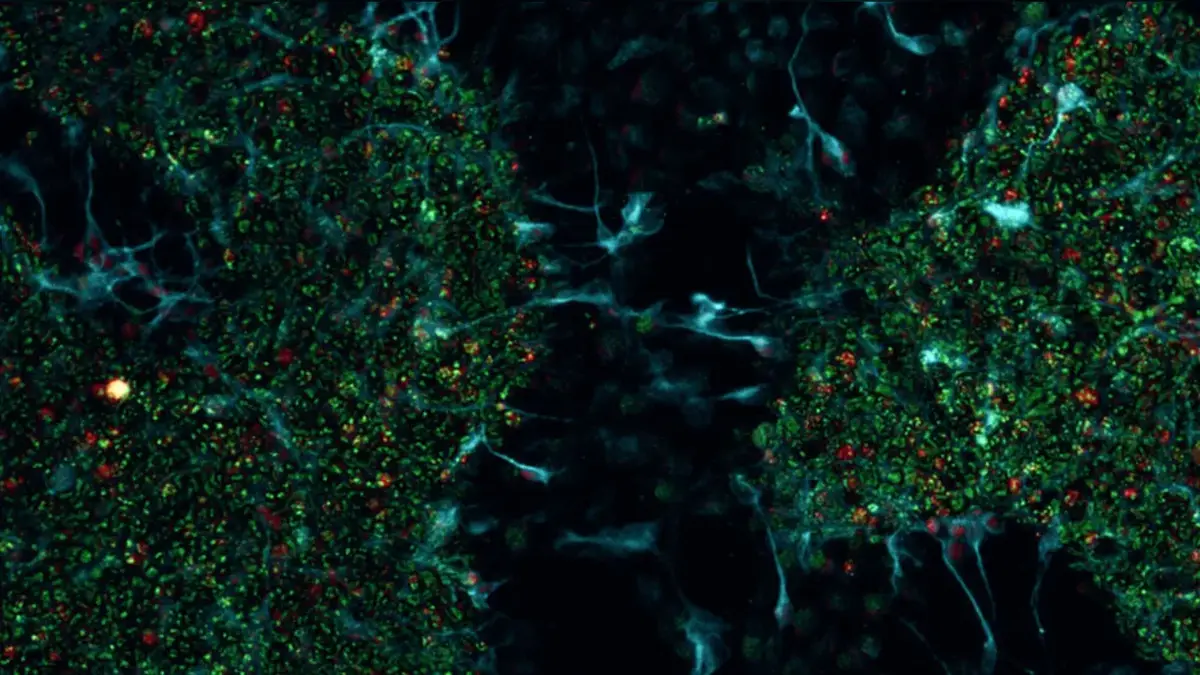

Australian company Cortical Labs has connected 15 of its biological computers to create a system called HIVE.
The setup brings together lab-grown human neurons, allowing separate groups to work on different parts of a problem.
Early experiments suggest the unusual approach could outperform conventional AI in certain tasks.
The world’s first biological computers are learning to work together
Cortical Labs unveiled the extremely futuristic HIVE at the first International Conference on Organoid Intelligence in Washington, D.C., on October 26 and 27.
The system connects 15 of the company’s CL1 biological computers, which use living human neurons grown in a lab and integrated with electronic hardware.
Rather than relying entirely on conventional computer chips and software, these machines use the activity of living brain cells to process information and learn from feedback.

The idea behind HIVE is simple: if one biological computer can learn to tackle a problem, connecting several could make the system even more capable.
And the results suggest that is exactly what is happening.
According to Cortical Labs, the connected computers appeared to divide tasks between different groups of neurons, with each group contributing to a shared result.
The researchers did not explicitly teach the neurons to specialize in this way, but instead, the behavior emerged when the individual systems were connected into a larger network.
The biological hive mind beat a conventional AI system
One of the most interesting experiments involved a virtual character navigating a grid to reach a target.
The researchers compared HIVE against a conventional AI system called Deep Q Network (DQN), which uses algorithms to learn how to make decisions.
In the test, DQN achieved around 32 percent of the maximum possible score, and the best individual Cortical Labs computer reached 40 percent.
When several biological computers worked together to decide which moves to make, that figure climbed to around 70 percent.

And when the researchers divided the work between specialist groups of biological computers, the score increased to approximately 80 percent.
HIVE also showed promising results in a separate symbol-recognition experiment. Cortical Labs reported that connecting seven biological computers improved accuracy from around 80 percent to 99 percent.
The findings suggest that linking biological computers could help them become more accurate and consistent than relying on a single system.
However, the results are still preliminary and apply to the specific experiments and AI model used in the comparison.
They do not mean biological computers have outperformed every type of AI.
Living computers could be more efficient and reliable
There is another potential advantage to connecting these machines: stability.
Because the systems rely on living cells, their performance can vary. One group of neurons might perform well on a particular day, while another might be less effective.
By sharing tasks across several biological computers, HIVE could reduce the impact of those fluctuations.
The setup could also continue operating if one group stopped responding, making the wider system more resilient.

The company now wants to investigate how neurons exchange information and process feedback across the connected machines, as well as whether adding more connections could improve performance further.
Energy efficiency is another potential benefit.
Biological computing could offer a different way to run certain machine-learning tasks while using less energy than conventional approaches, although the practical advantages will need further investigation.
For now, HIVE is an early demonstration of what could happen when biological computing moves beyond individual machines.
And if the results continue to improve, the future of computing might involve not just increasingly powerful chips, but networks of living brain cells working together - freaky, right?
A short timeline of Cortical Labs
- 2022
Cortical Labs demonstrates that lab-grown human brain cells can learn to play Pong.
- 2025
The company introduces its CL1 biological computer, combining living neurons with electronic hardware.
- October 26-27, 2026
Cortical Labs unveils HIVE, connecting 15 biological computers to work together on tasks.
- 2026
Early experiments show improvements in virtual navigation and symbol-recognition accuracy when biological computers collaborate.